
Boone County Court Record Requests
Start with Indiana MyCase for a cause number, public Chronological Case Summary, and selected public documents. For the official file, contact Lisa Bruder, Boone County Clerk. Her office maintains records for Boone Circuit, Superior I, and Superior II. The clerk is at 212 Courthouse Square, Lebanon, IN 46052, with posted hours Monday through Friday, 8 a.m. to 4 p.m. The phone is 765-482-3510 and the posted email is lbruder@co.boone.in.us.
The documented channels are online, counter service, mail, phone, email, the county disposition form, and the county APRA form. State guidance mentions a court or clerk public terminal, but Boone-specific terminal hours were not posted. Call first if that is the planned route.
- Find the cause number and exact document name.
- Check MyCase for the public CCS or image.
- Choose counter, mail, phone, email, disposition form, or APRA form.
- State whether inspection, plain copy, or certification is needed.
- Confirm the current fee and delivery time with the clerk.
Four Boone County Court Record Layers
The CCS is the official sequence of judicial events. The case file is broader and can hold pleadings, motions, service, returns, evidence, and filed transcripts. The Record of Judgments and Orders, or RJO, holds designated judgments and orders. The judgment docket records judgments requiring entry and the applicable amount. Indexes and public receivables are additional clerk records.
The Indiana Trial Rule 77 page defines these duties and record layers.
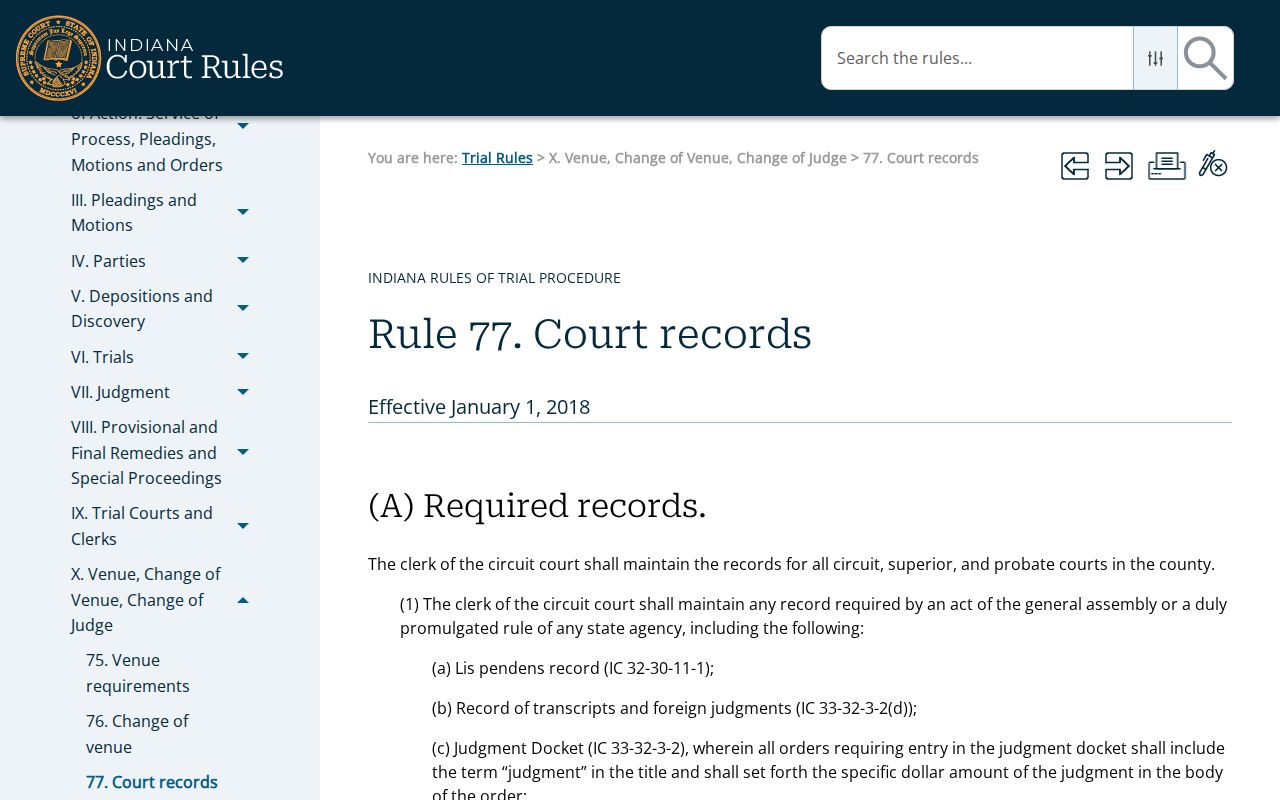
A request for the docket, full file, order, or judgment docket can produce different material, so name the layer before ordering.
Kinds of Court Records
Boone County court case records cover more than docket entries. The clerk maintains the judicial record while the judge causes court events and orders to be entered. MyCase is only the public Odyssey view. Records commonly sought include:
- the CCS and its dated event descriptions;
- pleadings, motions, service papers, and returns in the case file;
- orders, judgments, dispositions, and RJO entries;
- indexes, judgment entries, and public receivables;
- filed transcripts or other authorized hearing records.
Appellate briefs and the appellate event list sit in a separate appellate record. A hearing recording or transcript may require the reporter's procedure, court authorization, an Administrative Rule 9 request, and payment. No Boone-specific recording fee was found.
Boone County Court Record Access
Document access changes with the case type. Many criminal cases expose sentencing orders but not every pleading. Infraction, traffic, ordinance, small-claims, and some civil matters may show selected orders. Adoption, protection-order, juvenile, and sensitive family records have stronger limits. A public case shell can appear even when the document itself stays offline.
The Judicial Branch document-access matrix identifies online and in-person access by case category.
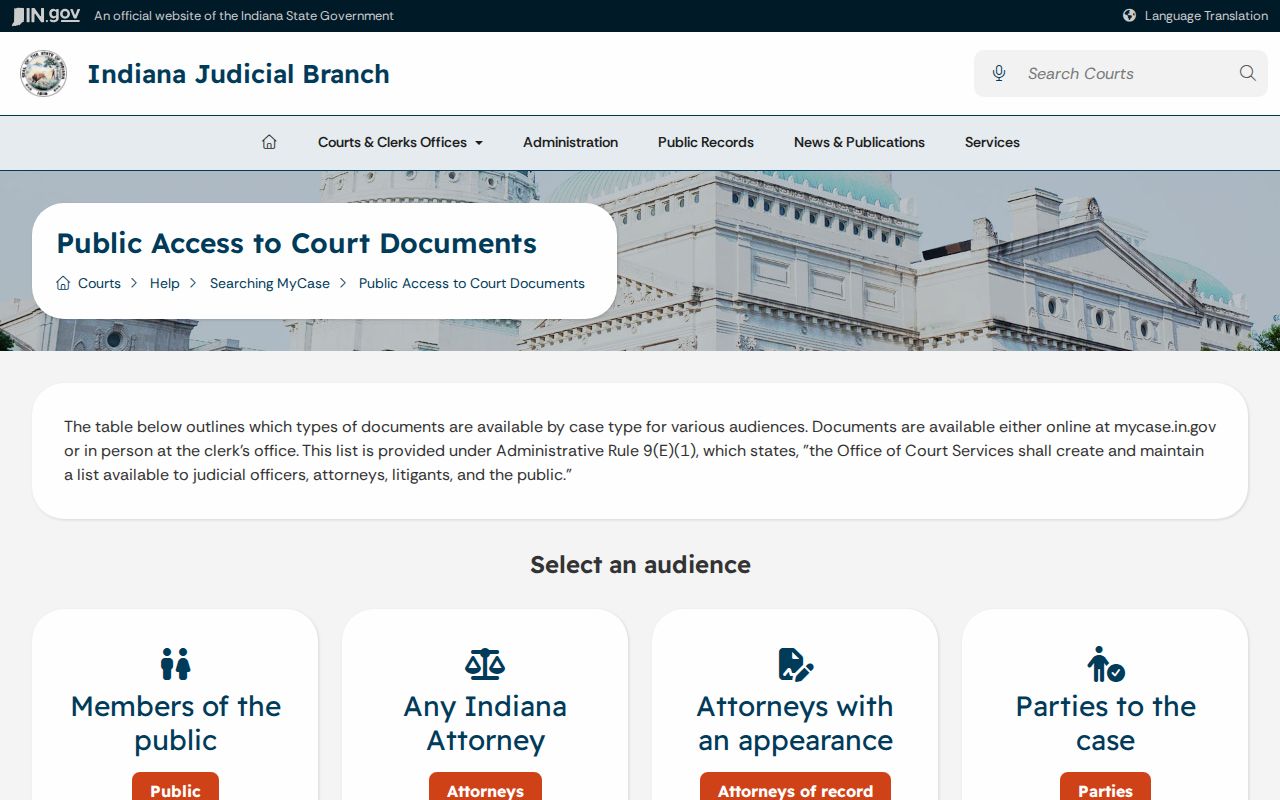
Use the current matrix rather than assuming that every e-filed document is open for download. E-filing is a filing channel, not a public-release decision.
Court Records: What They Contain
A Boone County CCS begins with the cause number, court, case type, caption, parties, counsel or self-represented status, filing date, judge, and case status. Its entries briefly identify filings, settings, orders, rulings, judgments, and financial assessments. The notation date is not always the date of the hearing or signature.
| Cause Number | Boone court identifier, case type, year, and sequence. |
|---|---|
| Pleadings | Complaints, petitions, answers, motions, and service records. |
| Orders | Judicial rulings, judgments, and designated RJO records. |
| CCS | Short, dated descriptions of judicial events. |
| Financials | Public fees, fines, judgments, payments, and receivables. |
A closed marker does not prove every payment, satisfaction, appeal, or later filing is reflected. Read the event history and ask the clerk for an official payoff or certified disposition when needed.
Boone County Court Record Forms
The Boone Clerk's online disposition and document request asks for requester name, email, phone, and defendant name. Company, cause number, and prepaid-account answers are additional fields. Document choices are probable cause, charging, sentencing, revocations, and other. The form does not post a fixed turnaround or total cost.
This form works best for a defined criminal document. A full-file inspection, civil order, judgment docket entry, transcript, or specially authenticated record should be discussed directly with the clerk. Include the cause number whenever possible. If a cause number is unknown, first use the Boone County docket search to locate the public case header.
Copy Fees and Certification
A plain copy reproduces a record. A certified copy carries clerk authentication. An exemplified or otherwise authenticated record and a certified transcript are different products. Boone's published fee page is marked effective July 1, 2021, so verify amounts before paying.
| Item | Posted Amount |
|---|---|
| Ordinary copy | $0.10 per page |
| Order copy | $1 per page |
| Certified pleading | $3 plus $1 per page |
| Docket-sheet search fee | Not located in official sources |
Boone County Court Record APRA Requests
The county APRA form asks for a specific record and lets a requester choose inspection or a copy. It notes advance payment of copying or recording charges and offers mail or PDF email delivery when possible. The completed form goes to the County Attorney at 127 W. Main St., Suite 400, Lebanon.
APRA is useful for a defined county administrative record or when the ordinary copy route is unclear. It is not a filing, a bulk person search, or a way around a court-record exclusion. Court rules still control the case file. For a large non-confidential compiled dataset, Administrative Rule 9(F) directs a separate Office of Court Services process with defined fields, dates, courts, format, and possible fees.
Access Rules for Court Records
Indiana court records begin with a presumption of public access, but statutes, rules, and court orders protect juvenile, adoption, protection-order, mental-health, sealed, expunged, and other confidential material. The state public-access guidance explains how court access rules work with the Indiana Access to Public Records Act.
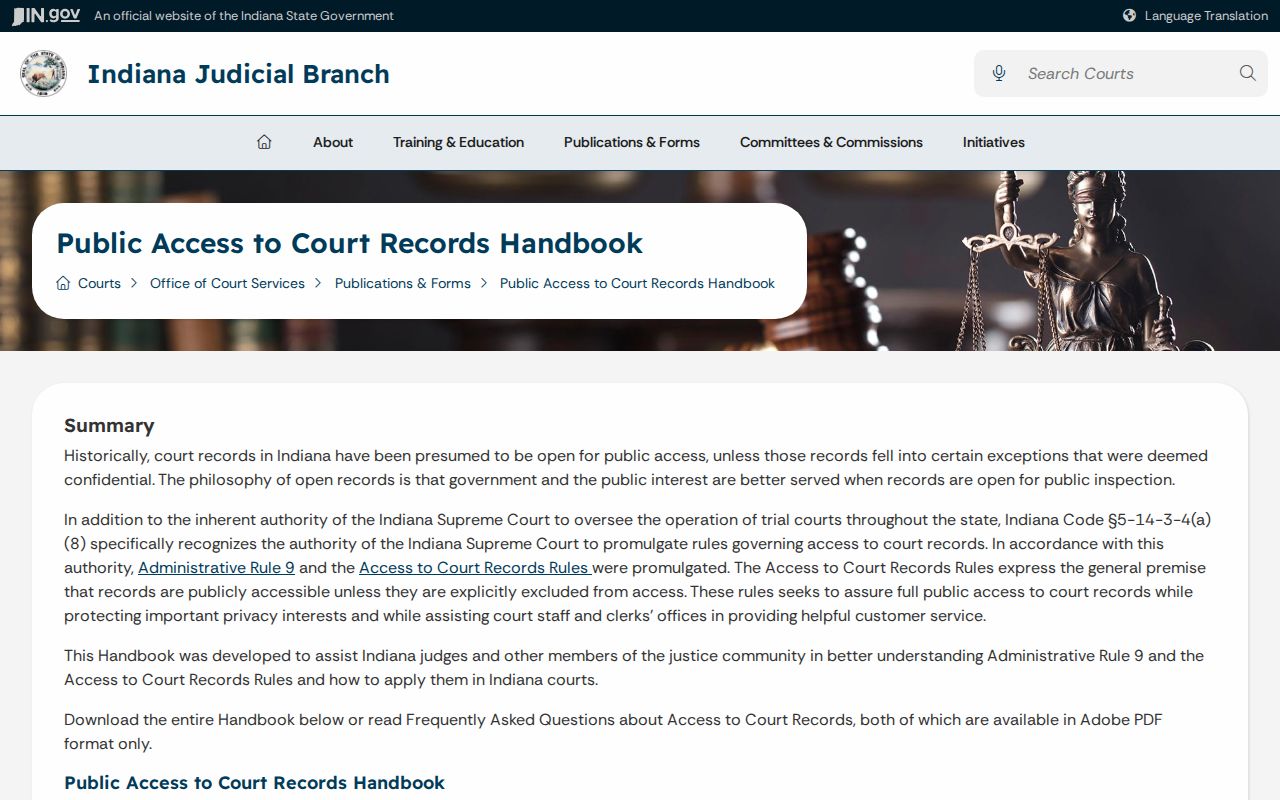
Open status does not make every personal field or attachment public. A missing image may be public at the counter, restricted by type, sealed, or not yet imaged.
Key Rules:
Indiana Code 5-14-3 supplies the general public-record framework.
Access to Court Records Rule 4 states the access premise.
Access to Court Records Rule 9 governs requests involving excluded records.
When Boone County Court Records Stay Missing
A no-results page is not proof that a Boone County court record does not exist. The matter may use a nonparticipating municipal court, an abolished historical court code, a transferred cause number, or a restricted case type. A public case may also lack an online document even though a non-confidential copy can be inspected at the clerk's office.
Start by checking the cause number and court identifier. Then ask the clerk whether the desired item is in the CCS, case file, RJO, judgment docket, or transcript channel. For an excluded item, identify the exact record and ask what Rule 9 request, party authorization, motion, or court order applies. Do not ask staff to send protected fields by ordinary email.
Municipal status is another source of confusion. Zionsville Town Court is current and has its own clerk channel. Lebanon City Court was reestablished in 2024, but its participation in the reviewed MyCase court list was not confirmed. Whitestown, Thorntown, and Jamestown court identifiers can belong to abolished courts and historical records. The date and court code help identify the current custodian. Appeals use the Indiana appellate docket, and federal records connected with Boone County belong in PACER or the Southern District of Indiana rather than the county clerk's file.